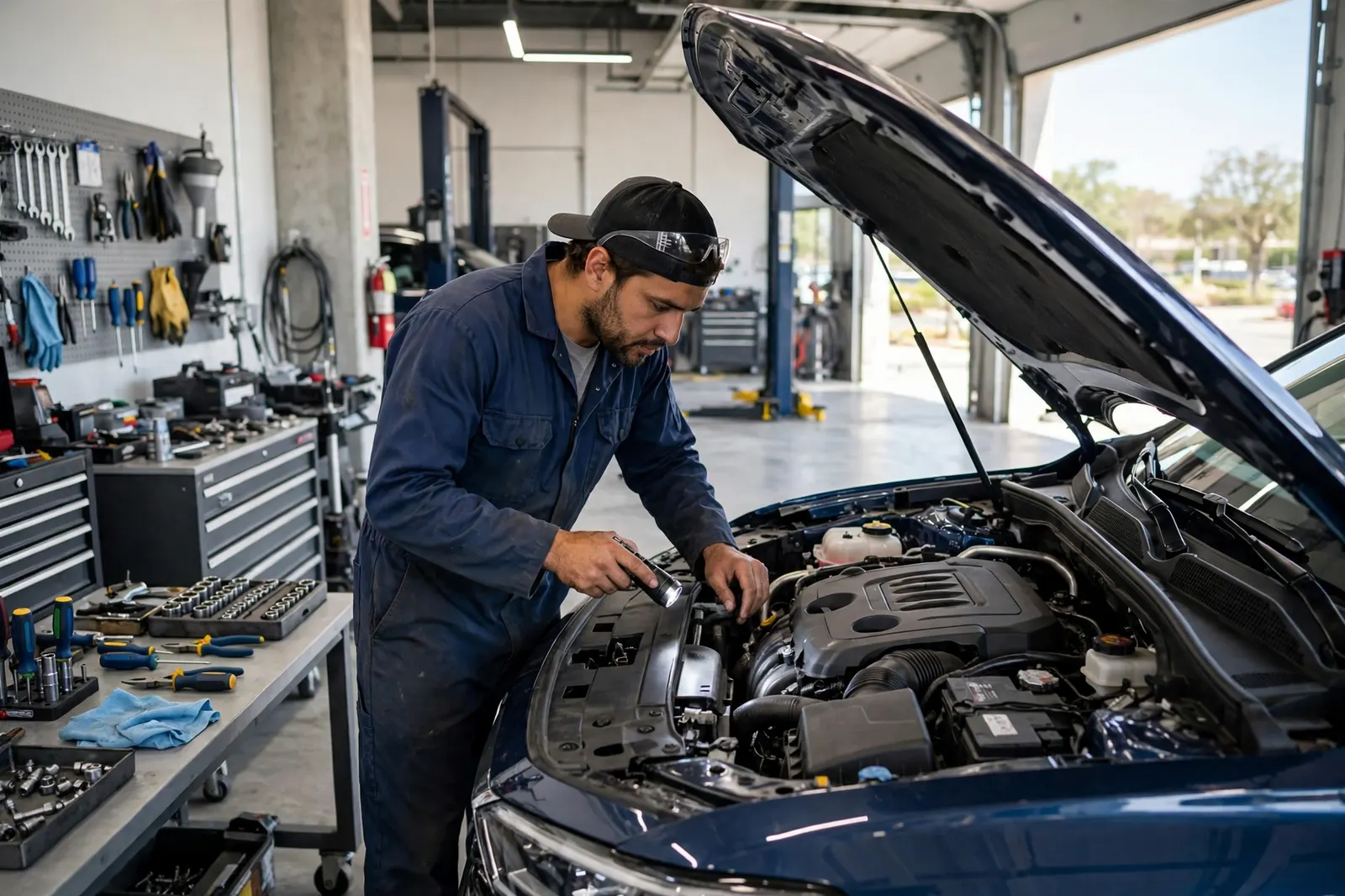
Short answer: Auto repair SEO in Austin is won across a spread-out metro, not in a single neighbourhood. Drivers search from where the car breaks down — downtown, Round Rock, Cedar Park, or the drive home on I-35 — and they call the shop Google and ChatGPT can verify nearest to them. Our two auto projects prove the pattern: Foreign Affairs Auto now draws 6.1K monthly organic visits, and Carage Auto has 137 pages cited in AI answers. This guide explains how Austin shops replicate that, town by town.
What to look for in auto repair SEO
Austin is not one market — it is a ring of them
Most auto repair marketing treats Austin as a single city, and that is the first mistake. A driver whose car overheats on the MoPac does not search the same way as a commuter in Round Rock or a family in Cedar Park, and Google knows the difference. The map pack a shop sees from its own front door is not the map pack a driver sees ten miles away. Shops that win in Austin win in rings: a strong profile and website at the centre, then visibility that extends into the suburbs where the growth is. Auto shops in the growth ring face the same map-pack fight — see how to rank in Georgetown, Round Rock and Cedar Park for the town-level strategy.
Look at your own data before spending anything. Check which towns your current customers come from, and your map-pack position from each of those towns, not just from the shop. The gap is the opportunity: a shop that ranks in its own neighbourhood but is invisible in the next town is leaving the easiest growth on the table, because the suburbs are where new households and new drivers are arriving fastest.
What the two case studies prove
Foreign Affairs Auto and Carage Auto are different businesses, and together they show the two halves of auto repair SEO. Foreign Affairs Auto proves the organic half: specialist content about the cars the shop actually works on, written in depth, now draws 6.1K monthly organic visits. That traffic comes from drivers searching for their specific car and their specific problem, not for generic "auto repair near me". Carage Auto proves the AI half: 137 pages cited in AI answers, which means ChatGPT, Perplexity, and AI Overviews are naming the business when drivers ask who to call. One proves that depth wins search; the other proves that direct answers win the new AI channel.
The lesson for any Austin shop is that neither half works alone. Organic traffic without AI citations misses the customers who ask an assistant first, and AI citations without organic depth have nothing to cite. The shops that grow fastest build both, on the same foundation: real service detail, real reviews, and business facts that agree everywhere.
EVs, hybrids, and the diagnostics question
Austin has more electric and hybrid vehicles on the road than most Texas metros, and their owners search differently. They ask about battery health, charging faults, and software updates — questions a general repair page cannot answer. A shop that publishes honest, specific content about the EVs and hybrids it actually services earns the search traffic for those questions and the AI citations, because AI engines favour pages that answer a precise question precisely. Do not claim to service cars you do not; do claim, in detail, the ones you do.
Why this happens: the map pack decides before the website
Drivers search from the breakdown, not from home
Auto repair searches are urgent and location-bound in a way few other searches are. A driver searches from the side of the road, from a parking lot, or from the office when the warning light comes on during the commute. Google answers with the map pack first, and the driver calls one of the top three results. That is why proximity, profile completeness, and review recency matter more here than in almost any other trade: the driver is choosing in seconds, with incomplete information, and the shop that looks open, near, and trusted wins the call. A beautiful website cannot rescue a profile that looks closed or a map listing that does not appear.
The Austin twist is distance. The metro is wide, the suburbs are growing, and a shop's natural radius is shorter than most owners think. Extending that radius is a deliberate job: local pages for the towns you serve, photos and reviews that mention those towns, and citations that tie the shop to each area. Without that work, a shop ranks on its own block and nowhere else. With it, the same shop appears to drivers across the ring — which is exactly the growth-ring pattern our Cedar Park and Round Rock guide describes for the north suburbs.
Why AI answers matter more for auto repair than for most trades
Drivers increasingly ask an AI assistant before they search: "my car is making a grinding noise when I brake, what should I do" or "best brake repair near me". The assistant answers with a short list of shops and a sentence about each, drawn from the same sources as search — pages that answer directly, profiles that agree, and reviews that mention the service. Carage Auto's 137 cited pages show what it takes: one page per real question, answered first, with the shop's facts stated plainly.
Step by step: the 90-day shop plan
Step 1: map your real service area
Write down the towns your customers come from, in order, and check your visibility from each one. Then build the map outward: a page or a section for each town you genuinely serve, with the local detail that proves it — the roads, the neighbourhoods, the commute routes. Add photos from the shop and reviews that mention the town. This is not keyword stuffing; it is evidence. Google and AI engines both reward pages that show a real connection to a place, and drivers trust a shop that clearly serves their town.
Step 2: build the proof pages
Pick the five services that bring in the most revenue and the five questions drivers ask most often, and make sure each has a page that answers it directly. The Foreign Affairs Auto result — 6.1K monthly organic visits — came from depth on the cars and problems the shop actually handles, not from a long list of thin pages. Add the facts drivers need before they call: what the job involves, how long it takes, and what affects the cost. Then add FAQPage schema so AI engines can lift the answer, and link each page to the towns it serves. Our guide to ranking in AI Overviews covers the answer-first structure these pages need.
Step 3: earn the reviews that mention the work
Reviews are the conversion signal and the ranking signal at the same time, and for auto repair the words inside the review matter. A review that says "fixed my brakes the same day" tells Google, AI engines, and the next driver more than one that says "great service". Ask customers at handover to mention the job. A steady flow of recent, specific reviews beats a large pile of old, generic ones, and it is the cheapest map-pack work there is.
The mistake to avoid: one page for every service
The mistake to avoid is buying leads instead of building visibility. Lead marketplaces sell the same call to several shops, and the shop that pays most wins the phone call, not the customer. A shop that owns its map pack and its AI citations gets the call directly, keeps the margin, and builds a reputation that compounds. The second mistake is treating the website as a brochure. A brochure does not answer "how much does a brake repair cost in Austin" or "which shop near Round Rock services Teslas", and those are the questions that bring in the work. Build pages that answer, and the calls follow.
Doing it yourself vs. calling a professional
You can start yourself: complete the Google Business Profile with your services by name, add photos of the actual shop, check your map-pack position from each town you serve, and ask every happy customer for a review at handover. A professional is worth calling when the work spreads to town pages, service pages for every high-value job, and the AI citation layer — or when you want the two halves built together, the way they were for Foreign Affairs Auto and Carage Auto. Local SEO and AI Search Optimization at Optimize Plus both start with a free audit of your shop. See our pricing plans for the ranges; prices may vary depending on the service and scope.
Auto Repair SEO in Austin
In Austin, an auto shop's market is the ring, not the block. Drivers in Round Rock, Cedar Park, Pflugerville, and Georgetown all search from where they are, and the shops that win are the ones visible in each town, not just in their own neighbourhood. That is why the north-metro pages matter so much for this trade, and why our Round Rock SEO and Cedar Park SEO pages are built as service hubs rather than generic city pages. Optimize Plus is based in Austin at 1431 Salem Meadow Cir, and serves the surrounding towns. For the wider local picture, read our 2026 local SEO checklist, which includes the profile and review routine this guide depends on.
How to prevent it coming back: the weekly shop routine
The weekly shop routine
Prevention fits into a normal working week. Every week, post one photo of a job in progress to the profile, ask every happy customer for a review, and answer any new reviews. Every month, check the map-pack position from each town you serve, and whether your shop is named when you ask ChatGPT and Google the questions drivers ask. Every quarter, re-read your five most important service pages and update the prices and the cars you service.
Keep the two halves growing together
Do not let organic and AI drift apart. Every new service page should be written to be quotable — direct answer first, FAQPage schema, facts stated plainly — so it can rank on Google and be cited by AI engines at the same time. Every new review and every new mention feeds both. The shops that keep both halves growing are the ones whose traffic and calls keep compounding, and the case studies prove it: 6.1K monthly organic visits on one side, 137 pages cited in AI answers on the other, both built from the same honest, specific content about real work on real cars.
Key takeaways
- Austin auto repair is won ring by ring — visibility in each suburb matters as much as visibility at home.
- Depth wins organic search: Foreign Affairs Auto draws 6.1K monthly organic visits from specialist content.
- Direct answers win AI: Carage Auto has 137 pages cited in AI answers.
- Reviews that name the job, and a weekly profile routine, hold the gains.
Want this system for your shop? Google Business Profile Management and AI Search Optimization both start with a free audit. We will show you your map pack position ring by ring.