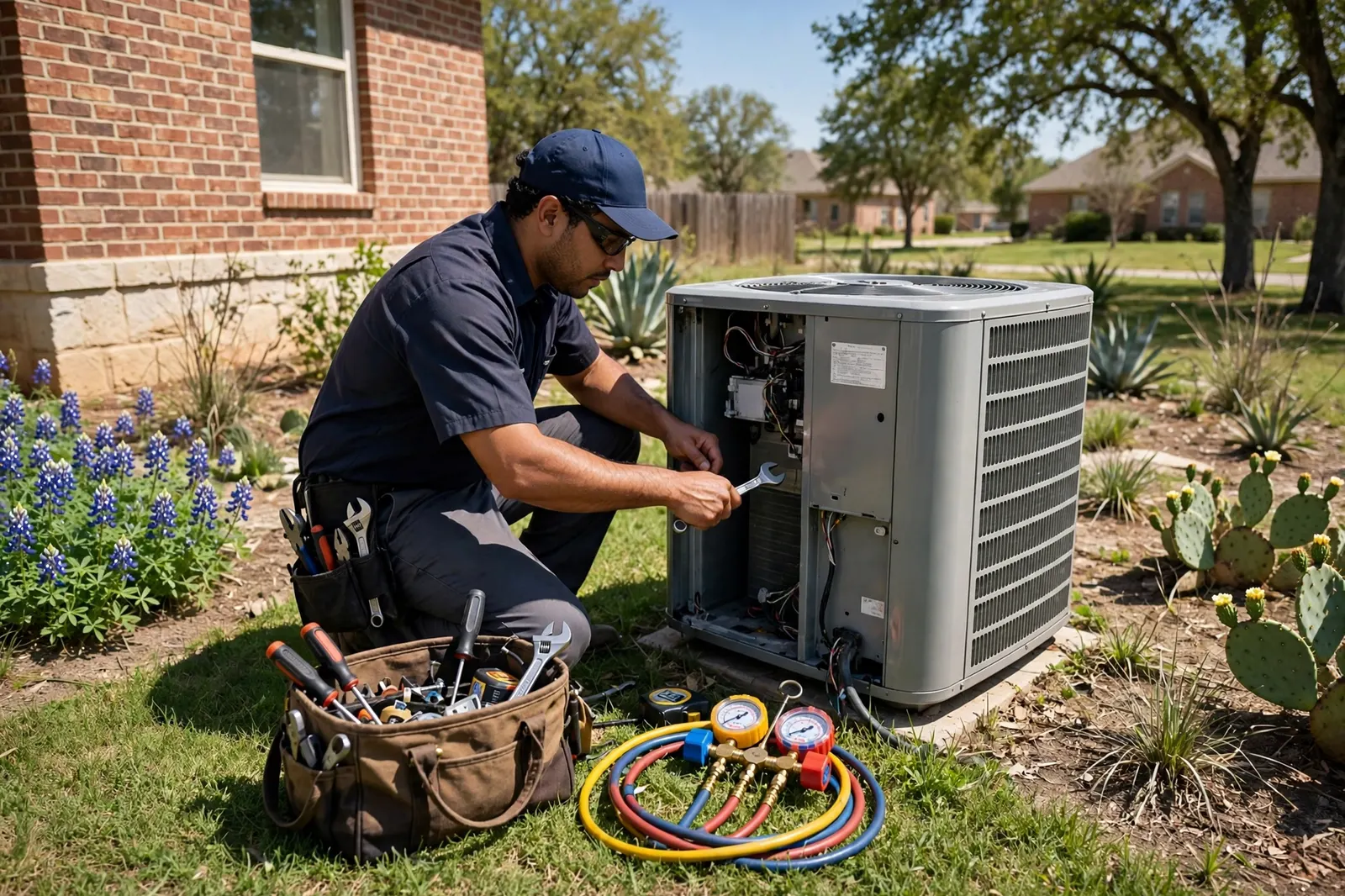
Short answer: HVAC SEO in Austin is the work of winning the map pack and AI answers for the jobs that pay — system replacements, emergency repairs, and maintenance plans — in a market where a broken air conditioner in August is an emergency, not a shopping trip. Customers search from a hot house, call the first trustworthy result, and book the company that answers. This guide covers the system behind that, including what our Air Tech Pro project shows about HVAC visibility in this market.

What to look for in HVAC SEO
Emergency searches decide the winner
Most HVAC searches are urgent. An air conditioner that dies on a 100-degree afternoon, or a furnace that fails on a cold night — the customer searches, scans the map pack, and calls. They do not compare ten websites. That means the map pack is the whole game for emergency work, and the profile is the storefront: services listed by name, photos of real work, hours that are correct, and recent reviews that mention the job. A company that wins the emergency call often keeps the customer for the replacement and the maintenance plan.
Check your own position the way a customer would: search for your money keywords from different parts of town, on a phone, and note where you appear. The position you see from your office is not the position a customer sees from theirs. If you rank in your own neighbourhood but not across town, your radius is the problem, and the fix is local content and citations for the areas you serve — the same growth-ring work our Cedar Park and Round Rock guide describes for the north suburbs.
Replacements, repairs, and maintenance are three markets
HVAC is not one search market; it is three. Emergency repairs are urgent, local, and decided in minutes. System replacements are considered, expensive, and researched over days — customers compare brands, efficiency ratings, and financing, and they read content before they call. Maintenance plans are recurring and loyalty-driven, won by the company that stays in touch. Each needs different pages: repair pages that answer fast and make calling easy, replacement pages that explain the options honestly, and maintenance pages that sell the plan, not the visit. A site with one generic "HVAC services" page serves none of the three well, and that is the most common HVAC SEO failure.
The replacement pages deserve the most depth, because a single replacement is worth many repairs. They should explain the options, the efficiency differences, the installation process, and what affects the cost — in plain language, without jargon. Customers who understand the choice trust the company that explained it, and AI engines cite the page that explained it best. Depth on replacements is also what earns the links and mentions that lift the whole site.
Seasonality is a planning tool, not a surprise
Austin HVAC demand is seasonal in a way few trades are: summer is emergency season, spring and autumn are replacement and maintenance season, and winter brings the heating calls. A smart SEO plan works against that calendar, not with it. Build the replacement and maintenance pages in the quiet months, so they are ranking when the season turns. Publish the emergency content before summer, not during it. And use the slow season for the technical work — the site fixes, the profile updates, the review push — that is hard to do when the phones are ringing. A company that plans by the season never has to choose between answering calls and doing marketing.
Why this happens: emergency searches decide in seconds
Heat makes the search urgent and local
Austin summers turn air conditioning into a necessity, and necessity changes how people search. They search on a phone, they search with "near me", and they call the first result that looks open and trustworthy. Google knows this, and the map pack reflects it: proximity, profile completeness, and review recency matter more here than in almost any other trade. A company with a complete profile and fifty recent reviews will beat a company with a better website and an empty profile, because the customer is choosing in seconds and the profile is what they see first. That is why Google Business Profile Management is the first line of HVAC SEO, not an afterthought.
The second reason is trust. A customer is inviting a stranger into their home to work on an expensive system, and the signals that build trust are specific: reviews that mention the technician by name, photos of real installations, and content that explains the work honestly. Generic claims — "best service", "lowest prices" — build no trust at all. The companies that win in Austin are the ones whose online presence reads like a real local business, because it is one.
Why AI answers are taking HVAC calls
Customers increasingly ask an AI assistant before they search: "my AC is blowing warm air, what should I do" or "best HVAC company near me". The assistant answers with a short list and a sentence about each, drawn from pages that answer directly and profiles that agree. A company with no quotable pages is not in that list, and the customer never sees its name. The fix is the same answer-first structure that works for search: one page per real question, the answer first, the facts stated plainly, and FAQPage schema so the answer can be lifted. Our guide to ranking in AI Overviews covers that structure in detail.
Step by step: the seasonal HVAC plan
Step 1: fix the profile and the radius
Start with the profile: services listed by name — AC repair, AC installation, furnace repair, heat pumps, ductwork, maintenance plans — with photos of real work and hours that are correct, including emergency hours. Then check the radius: search from each town you serve and note where you appear. Build the local pages for the towns where you are invisible, with the local detail that proves you serve them. This is the foundation, and it is the work that produces the fastest results, because the map pack moves faster than organic rankings.
Step 2: build the replacement pages
Build one strong page per high-value job: system replacement, heat pump installation, ductless mini-splits, and the maintenance plan. Each page should explain the options, the process, the timeframe, and what affects the cost, and each should end with a clear next step — a call, not a form, because an HVAC customer with a broken system wants to talk to a person. Add FAQPage schema to each, and link them to the towns they serve. These pages are the asset that keeps producing long after the campaign ends, and they are the pages AI engines cite when a customer asks which company to call.
Step 3: earn reviews that name the job
Reviews are the conversion signal and the ranking signal at the same time, and the words inside them matter. A review that says "replaced our AC the same week, explained everything" tells Google, AI engines, and the next customer more than one that says "great service". Ask every happy customer at the end of the job, and ask them to mention what was done. A steady flow of recent, specific reviews beats a large pile of old, generic ones, and it is the cheapest map-pack work there is. Answer every review, because a company that answers looks like a company that cares.
The mistake to avoid: one page for every HVAC service
The mistake to avoid is buying leads instead of building visibility. Lead marketplaces sell the same call to several companies, and the one that pays most wins the phone call, not the customer. A company that owns its map pack and its AI citations gets the call directly, keeps the margin, and builds a reputation that compounds. The second mistake is a single generic services page. Customers search for the specific job — AC repair, furnace replacement, mini-split installation — and a page that does not name the job does not win the call.
Doing it yourself vs. calling a professional
You can start yourself: complete the profile with your services by name, add photos of real work, check your map-pack position from each town you serve, and ask every happy customer for a review at the end of the job. A professional is worth calling when the work spreads to replacement pages, town pages, and the AI citation layer, or when you want the system built the way it was for Air Tech Pro. Local SEO and AI Search Optimization at Optimize Plus both start with a free audit of your company. See our pricing plans for the ranges; prices may vary depending on the service and scope.
HVAC SEO in Austin
In Austin, HVAC SEO is shaped by the heat and by the sprawl. The emergency season is long, the metro is wide, and the suburbs — Round Rock, Cedar Park, Pflugerville, Georgetown — are where the new systems are being installed. A company that ranks in Austin proper but is invisible in the north suburbs is missing the growth. Optimize Plus is based in Austin at 1431 Salem Meadow Cir, and serves the surrounding towns. For the local foundation, read our 2026 local SEO checklist, which includes the profile and review routine this guide depends on.
How to prevent it coming back: the seasonal routine
The seasonal routine
Prevention follows the seasons. Before summer, check the profile, the emergency pages, and the review flow, and make sure the phone is answered. In the quiet months, build the replacement pages, fix the technical problems, and push for reviews from the customers you served in the rush. Every month, check the map-pack position from each town you serve, and check whether your company is named when you ask ChatGPT and Google the questions customers ask. The routine is short, and it is the difference between a company that holds its position through the season and one that slides while a competitor does the routine instead.
Keep the proof fresh
Models and customers both favour recent evidence. A steady flow of new reviews beats a large pile of old ones, and a new installation photo or a new case study beats a page that has not changed in a year. Keep publishing one piece of proof a month — a completed job, a detailed service page, an answer to a question customers are actually asking. And keep your facts consistent when anything changes: a new phone number, a new service area, or a rebrand must be updated on the website, the profile, and the directories in the same week.
Key takeaways
- Emergency work is won in the map pack, in seconds, from a phone.
- Replacements, repairs, and maintenance are three markets — build a page for each job.
- Reviews that name the job, and a seasonal routine, hold the gains.
- Answer-first pages win both Google rankings and AI citations.
Want this system for your company? Local SEO and AI Search Optimization both start with a free audit. We will show you the emergency searches you are losing today.