Air Tech Pro HVAC operates in one of the most competitive local services categories in North America — head-to-head with national brands running six-figure paid budgets and franchise networks with decades of review volume.
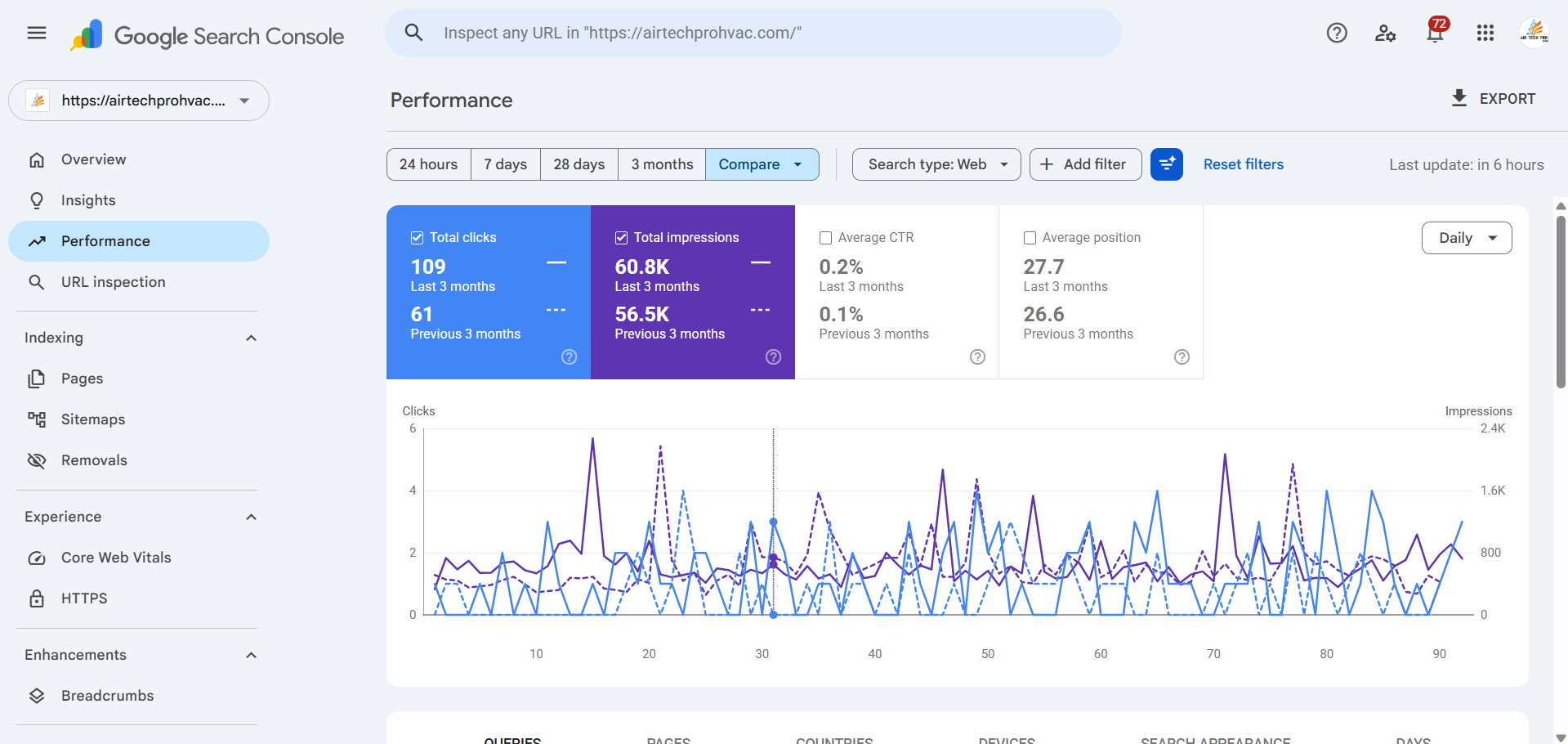
In three months we shipped a service-area page set, overhauled the Google Business Profile, and fixed Core Web Vitals — and generated 60.8K impressions and a 78% lift in clicks against a compressed timeline that left no room for slow iteration.
This is what local SEO looks like when it's done as a system rather than a checklist: page architecture, profile optimisation, and technical performance shipped in parallel, each reinforcing the others rather than competing for priority.
Every number on this page is sourced.
Metrics below are captured directly from Google Search Console, GSC during the engagement window (2026).
The economics of local services SEO
The category is brutal by design. National HVAC brands buy visibility outright through paid search and local services ads; small operators either compete on organic plus the local map pack, or they lose the qualified-enquiry pipeline entirely to competitors with paid budgets they can't match.
Air Tech Pro had a technically decent site — reasonable load times, no glaring crawl errors — but no service-area page set, thin content on core services, and inconsistent local pack visibility that swung week to week without a clear pattern the team could explain.
The audit also flagged mobile usability friction on the contact and quote-request flow — the exact moment a local-services visitor decides whether to call or bounce to the next result.
Service-area pages built for how HVAC is actually searched
We built the service-area page set first — HVAC repair, AC installation, furnace repair, each by city — because that's what wins both the local pack and the long-tail 'service + city' search pattern that dominates this category's query volume.
Twelve cities across four services meant 48 distinct pages, each with genuinely differentiated local content (service radius, typical response time, neighbourhood-specific notes) rather than a templated city-name swap, which search engines increasingly discount as thin duplicate content.
- Service-area page set (12 cities × 4 services)
- Unique local content per page, not templated swaps
The Google Business Profile as a growth lever, not an afterthought
In parallel, the GBP got rebuilt from the ground up: categories re-audited against competitor overlap, services list expanded and matched to actual search demand, service areas configured properly, geo-tagged photos uploaded on a schedule, a structured review-generation flow put in place, and weekly posts to keep the profile signalling activity.
For a local-services business, the GBP is frequently a bigger growth lever than the website itself, because the local pack sits above organic results for the exact commercial queries ('AC repair near me') that drive phone calls. Treating it as a one-time setup task rather than an ongoing programme is the single biggest missed opportunity we see in this category.
- GBP overhaul + review generation
- Weekly posting cadence
- Geo-tagged photo schedule
Core Web Vitals and the quote-request funnel
Technical work ran in the background of the page-build and GBP work: mobile usability fixes on tap targets and viewport scaling, LCP improvements on the service pages carrying the most paid-search-equivalent value, and HVACBusiness plus FAQPage schema deployed on every service page.
We prioritised CWV fixes on the pages feeding the quote-request form specifically, since a slow-loading contact flow on mobile — where most of this category's search traffic originates — is a direct leak in the conversion funnel that no amount of ranking improvement can fix downstream.
- HVACBusiness + FAQPage schema
- LCP improvements + mobile CWV pass
- Quote-request flow prioritised for mobile fixes
Seasonal content matched to the buying calendar
HVAC demand is sharply seasonal, so the content calendar was built around the buying calendar rather than a generic evergreen list: pre-summer AC tune-up content, winter furnace-readiness content, and indoor air quality content that performs year-round and captures a broader, less price-sensitive audience.
Reading clicks and position together in a tight window
With only a three-month window, we set up weekly rather than monthly GSC reviews so any early signal — positive or negative — could be acted on inside the engagement rather than surfacing in a wrap-up report too late to matter.
Impressions and clicks were tracked separately for the new service-area pages versus the existing site, which let us isolate exactly how much of the click growth was attributable to the new page set versus general site momentum.
Honest retrospective
Given more runway, we'd have staged the service-area page rollout to launch a smaller batch first and validate the local content pattern before committing to all 48 pages at once — it worked, but a phased approach would have de-risked the investment.
We'd also start the review-generation flow in week one rather than as part of the broader GBP overhaul; review velocity is one of the slower-moving local ranking factors, so every week of delay there is a week of compounding lost.
Three months, sprint by sprint
Weeks 1–2: audit, GBP category re-audit, and mobile usability triage.
Weeks 3–6: service-area page set built and published in staged batches; CWV fixes shipped in parallel.
Weeks 7–9: GBP overhaul complete, review-generation flow live, weekly posting begins, schema deployed.
Weeks 10–12: seasonal content published; weekly GSC reviews confirm the click and impression trend; final reconciliation.
Clicks up 78% in a market that punishes complacency
Clicks grew from 61 to 109 (+78%) on 60.8K impressions. Average position is 27.7 and improving — every point of position gained in this category compounds because the CTR curve is steep at the top, meaning small position gains translate into outsized click gains near page one.
If your business looks like this one
If you're a local-services business competing against national or franchise brands with paid budgets you can't match, the organic and local-pack lane is still winnable — but only if the service-area architecture, the Google Business Profile, and the mobile conversion funnel are all treated as one connected system rather than three separate line items on a proposal.
Deliverables & stack
Deliverables
- Service-area page set
- GBP overhaul & review flow
- Technical CWV fixes
- Editorial calendar (12 posts)
Tools & stack
Want results like this?
Book a free strategy call. We'll audit your organic footprint and tell you honestly whether we're the right fit.
Book a strategy call →
